


Page 25 - O Οργανισμός Αστικών Συγκοινωνιών Θεσσαλονίκης από το 1957 μέχρι σήμερα | The Organisation of Urban Transportation of Thessaloniki from 1957 to the present day
P. 25
Introduction
The 1950s were to be decisive for urban transport in Thessaloniki. The competition between trams and buses finally ended in favour of the latter. The fact that buses served a larger area of Thessaloniki, especially outside the city centre, in areas where a large section of the workforce lived, combined with government pol- icy, which favoured buses, resulted in trams gradually becoming less and less relevant. Their lines were grad- ually phased out, some of their routes were reduced, and their fleet was not renewed. The transfer of elec- tric lighting from KETITH to the Public Power Corpo- ration (DEI) in 1952 resulted in the state-owned com- pany retaining only the less profitable tramways (KET-
TH). With the loss of the ‘profitable’ electric lighting, KETTH now only had deficit budgets, unable to main- tain the current tram network.
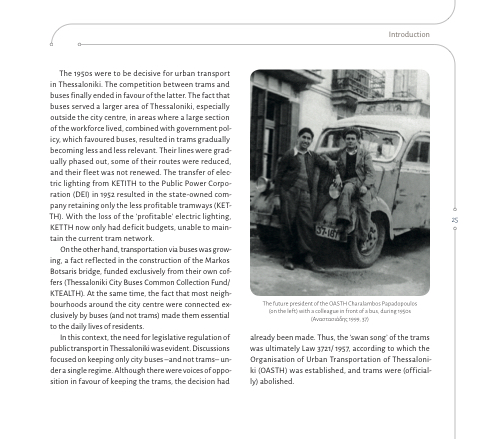
On the other hand, transportation via buses was grow- ing, a fact reflected in the construction of the Markos Botsaris bridge, funded exclusively from their own cof- fers (Thessaloniki City Buses Common Collection Fund/ KTEALTH). At the same time, the fact that most neigh- bourhoods around the city centre were connected ex- clusively by buses (and not trams) made them essential to the daily lives of residents.
In this context, the need for legislative regulation of public transport in Thessaloniki was evident. Discussions focused on keeping only city buses –and not trams– un- der a single regime. Although there were voices of oppo- sition in favour of keeping the trams, the decision had
25
The future president of the OASTH Charalambos Papadopoulos (on the lef t) with a colleague in front of a bus, during 1950s (Αναστασιάδης 1999, 37)
already been made. Thus, the ‘swan song’ of the trams was ultimately Law 3721/ 1957, according to which the Organisation of Urban Transportation of Thessaloni- ki (OASTH) was established, and trams were (official- ly) abolished.


